
There are paintings within the painting.





It brings together beauty, faith, love, danger, memory, and transformation, suggesting a journey through the contradictory forces that shape human life.
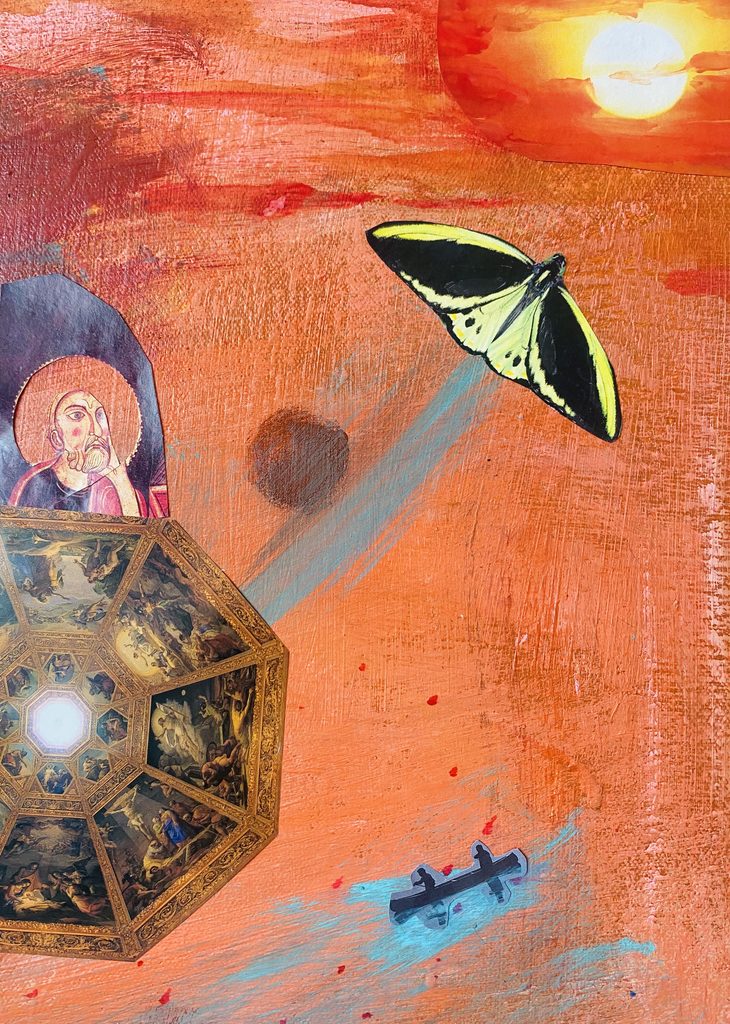
The burning orange and red background creates an atmosphere of intensity. It can evoke passion, desire and vitality, but also turmoil, danger and emotional upheaval. The setting sun reinforces the idea of transition—the ending of one period and the approach of another. Yet because the sun remains luminous, there is still light within the darkness.
At the centre is an ornate architectural dome, filled with historical or religious imagery. Its geometry and order contrast strongly with the expressive, almost chaotic painted background. It can represent civilization, human knowledge, culture, memory, or the attempt to create order and meaning within an unpredictable world. The sacred figure rising above it introduces faith and spiritual contemplation, suggesting a search for something beyond material existence.
The bluebird provides one of the artwork’s strongest symbols of hope. Bluebirds have long been associated with happiness, optimism, renewal and the return of light. Here, its brilliant blue stands dramatically against the fiery environment. It can therefore represent hope surviving in the midst of chaos—something beautiful and vulnerable that nevertheless remains present.
The butterfly represents the completion of that transformation—freedom, beauty, rebirth and emergence into a new state of being.
But transformation is never guaranteed.
The beautiful bluebird introduces this contradiction. At first it appears peaceful and hopeful, yet the bird is also dangerous to the worm because it can eat it and end the cycle before transformation ever takes place. Beauty, therefore, does not necessarily mean safety. Something attractive or seemingly innocent can also represent danger. The bird becomes both a symbol of beauty and a reminder of how vulnerable we are while we are still becoming who we are meant to be.
This creates one of the central ideas of the artwork: the journey from worm to butterfly is possible, but fragile. Life contains forces that can interrupt transformation before it is complete.
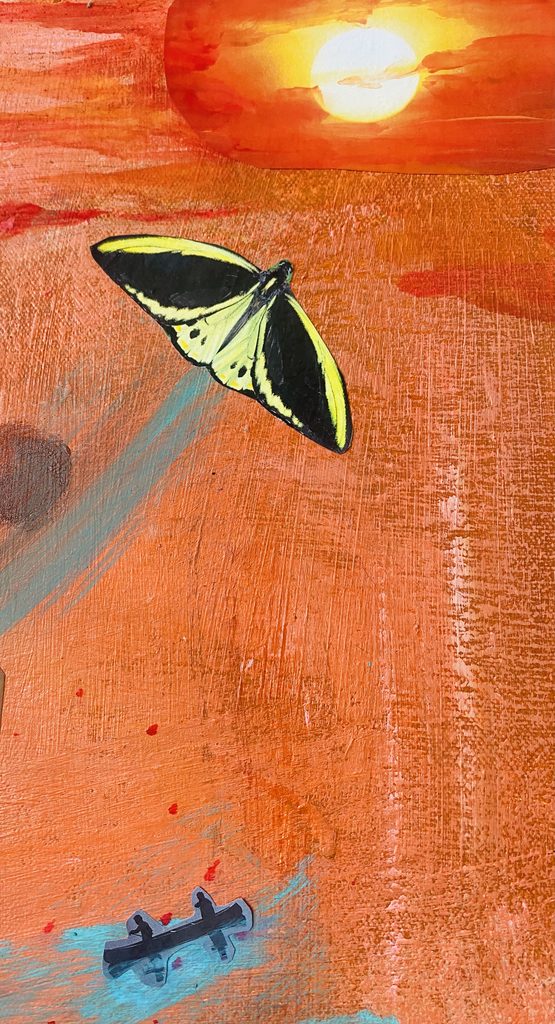
The butterfly similarly suggests transformation, renewal and the possibility of becoming something new. Butterflies are especially powerful symbols because transformation requires the disappearance of an earlier form before a new one emerges. Positioned high in the composition, the butterfly seems to move toward freedom, reinforcing the idea of spiritual or emotional change.
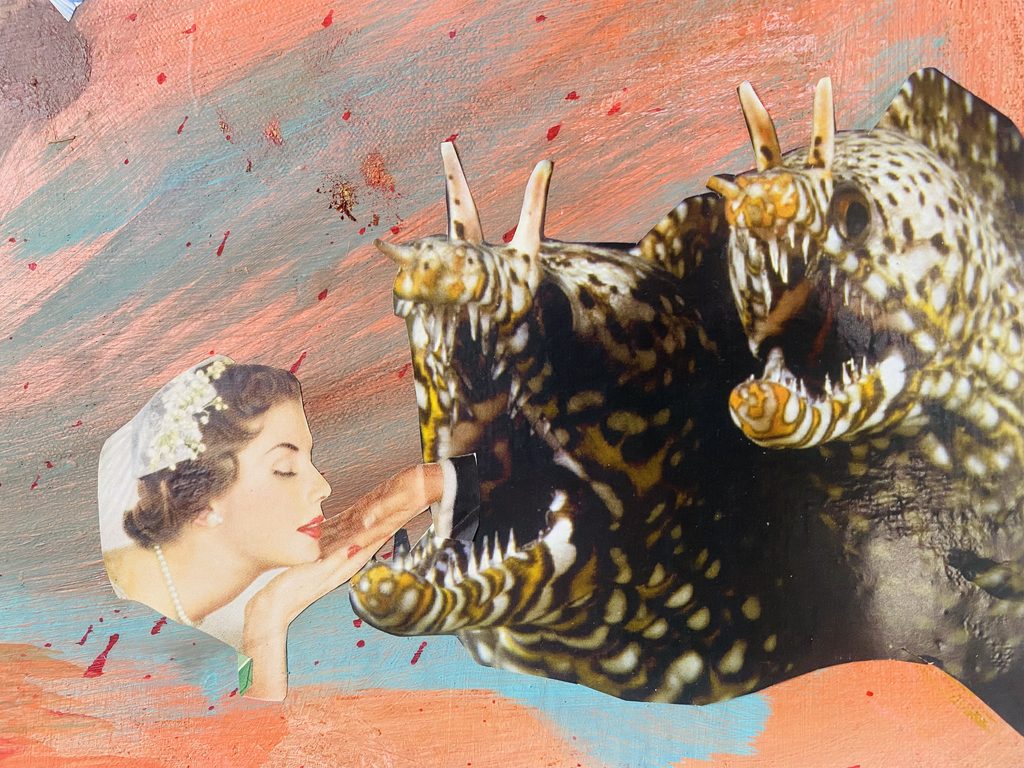
Near the bottom, the woman in bridal attire introduces another kind of transformation. A bride traditionally stands at a threshold between one life and another, so she may symbolize love, commitment, femininity, innocence, hope or the expectations attached to romantic love. Yet her tenderness is placed immediately beside the enormous two-headed beast, creating a striking contradiction.
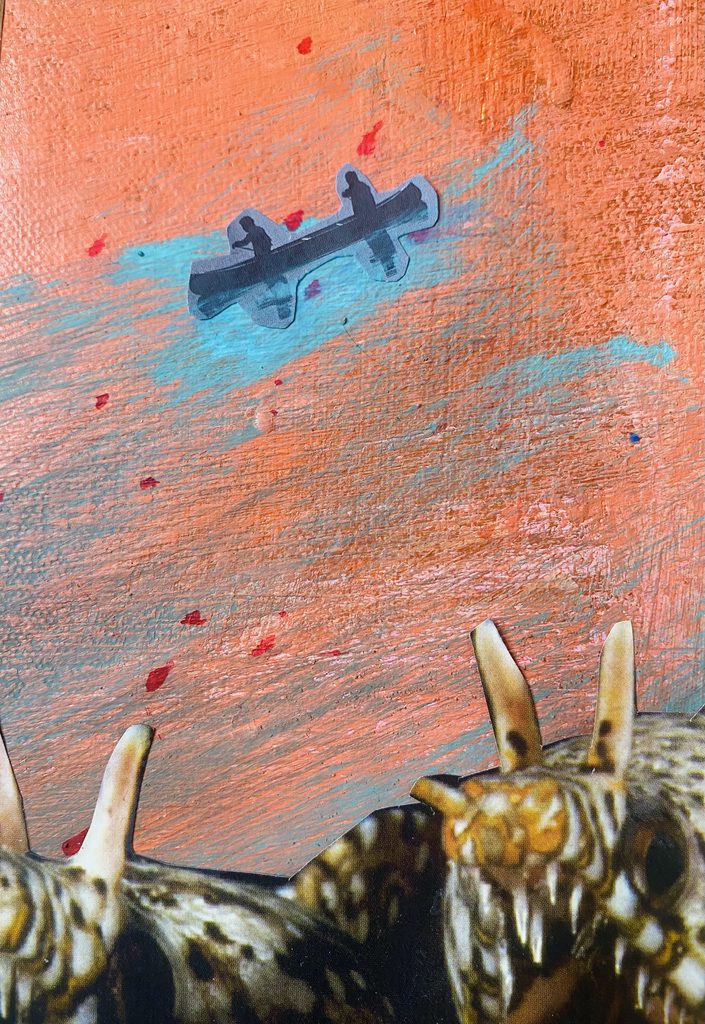
The beast can be interpreted as fear, conflict, destructive relationships, inner demons, or the darker side of human nature. Its two heads may suggest duality: two competing realities, conflicting emotions, or a danger that has more than one face. The woman’s gesture toward it is especially meaningful. Rather than running away, she appears almost to offer affection to something frightening. This creates ambiguity: Can love transform darkness, or can innocence sometimes fail to recognize danger?
The small canoe carrying two figures reinforces the idea of a journey. Against the enormous scale of the surrounding world, the people appear tiny and vulnerable. They may represent two individuals travelling through life together, navigating emotional uncertainty while surrounded by forces far larger than themselves.
Even the small dark and luminous forms at the lower left contribute to the tension between light and shadow, presence and absence, hope and fear.
Overall meaning
Taken together, the artwork can be read as an exploration of the human journey between love and fear, faith and uncertainty, beauty and danger, innocence and experience. The bride and monster embody this tension most dramatically, while the bluebird and butterfly offer counterweights of hope and transformation. The sacred imagery suggests the human search for meaning, and the distant travellers remind us that life itself is a passage through forces we cannot completely control.
What makes the piece compelling is that it does not present darkness and beauty as separate worlds. They exist simultaneously. Love can exist beside fear; hope can survive within chaos; beauty can emerge from difficult experiences; and transformation can occur precisely because life contains uncertainty.
Recent Comments